

How a Potash Plant Gained More Process Visibility with Faster Mag
How a Potash Plant Gained More Process Visibility with Faster Mag
Case Study
From Two Samples a Day to More Than 30: Tracking Magnetite Losses in a Potash Processing Plant
International Minerals Carlsbad (IMC)
Application
Magnetite-loss testing and process monitoring
Location
Carlsbad, New Mexico
Results at a Glance
- Sample processing time reduced from approximately 2 hours to 10 minutes
- Testing increased from roughly 2 samples per day to more than 30
- Reduced repetitive manual separation work
- Customer reports more consistent and reliable results
- More frequent sampling provides substantially greater visibility into the plant process
The Challenge
At the International Minerals Carlsbad (IMC) potash processing operation in Carlsbad, New Mexico, plant personnel routinely test process samples to determine where magnetite is being lost throughout the processing circuit.
Magnetite is used in the plant’s heavy-media separation system to help separate valuable potassium-bearing minerals from unwanted material. After performing its function, the magnetite is intended to be recovered and reused.
When magnetite begins appearing in locations where it should not, personnel must determine where it is escaping from the circuit.
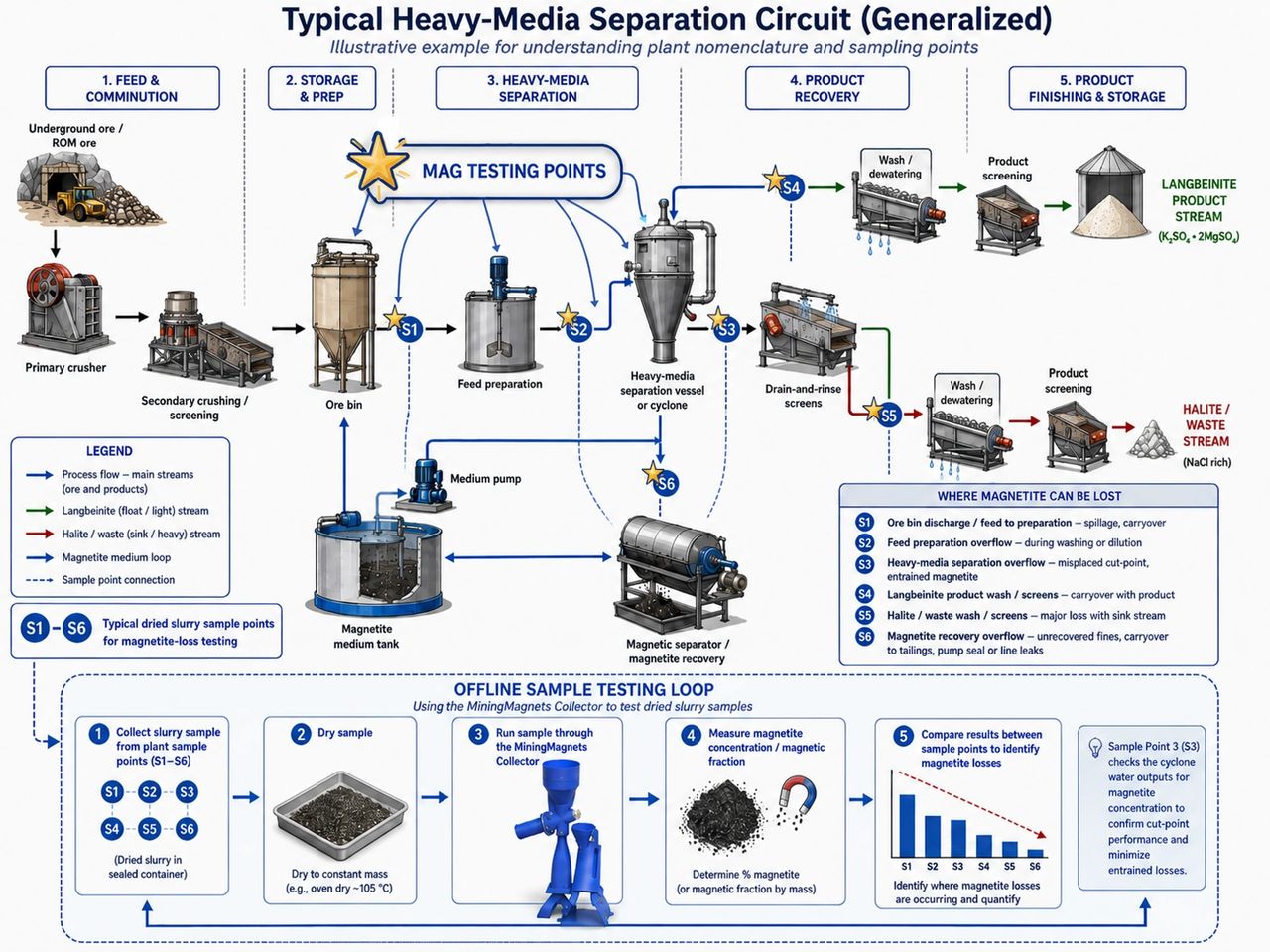
To investigate this, slurry samples are collected from multiple points throughout the plant, dried, and analyzed for magnetite content. By comparing results between sample locations, personnel can narrow down where losses may be occurring between pieces of equipment.
At Sample Point 3 on the accompanying generalized process diagram, for example, personnel evaluate water streams leaving the cyclone area for magnetite concentration.
The testing itself was not new.
The challenge was the time required to complete it.
Understanding the Potash Process
Potash is a general term for potassium-bearing mineral products used primarily in fertilizer production.
The deposits in the Carlsbad region were formed from ancient evaporated saltwater bodies that left behind layers of salt and potassium-bearing minerals underground.
Mining extracts the ore, but the valuable mineral must still be separated from salt, clay, and other materials.
The basic process is:
Mine → Crush → Size → Separate → Recover → Wash → Finish
The IMC operation processes langbeinite, a naturally occurring mineral containing potassium, magnesium, and sulfur.
After mining, the ore is crushed and screened into a controlled particle size distribution.
Water is then added, creating a mixture of solids and liquid known as a slurry.
Within the plant, material moving between equipment is commonly referred to as a stream, while the interconnected system of equipment is referred to as a circuit.
Where Magnetite Fits In
One stage of the process uses heavy-media separation.
Finely ground magnetite is mixed with water to create a slurry with a precisely controlled density. This forms the heavy medium, which allows separation of minerals based on density differences.
Ore is introduced into separation equipment such as a cyclone, where materials are divided into different streams.
In simplified terms:
- Float refers to material reporting to the lighter stream
- Sink refers to material reporting to the heavier stream
- Concentrate is the desired product stream
- Tails or rejects are the unwanted material
Magnetite itself is not the final product. It is a process medium used to enable separation.
After separation, the plant attempts to recover the magnetite and return it to the circuit:
Use the magnetite → Separate the minerals → Recover the magnetite → Return it → Repeat
If magnetite is lost to water, product, waste, or other streams, it represents material that should have remained in circulation.
These losses can also indicate where the process may not be operating as intended.
Following Magnetite Through the Plant
Sampling allows personnel to track magnetite behavior at different points in the circuit.
If one sample shows expected magnetite levels and the next shows an unexpected change, the investigation becomes more focused.
Instead of asking:
“Where are we losing magnetite in the plant?”
personnel can ask:
“What changed between these two sample points?”
Additional samples can then be collected around that area to further isolate the source.
Depending on the location, personnel may be evaluating:
- Cyclones
- Screens
- Pumps
- Pipelines
- Magnetic separators
- Rinse-water streams
- Tanks or other process equipment
The more samples that can be processed, the clearer the understanding of the circuit becomes.
The Previous Method
Before the MiningMagnets Collector was introduced, much of the magnetic separation required for these tests was performed manually.
According to IMC personnel, processing a single sample could take approximately: 2 Hours
The work was also repetitive in nature.
Operators reported that fatigue could begin after approximately 10 minutes of manual separation.
As a result, a full two-hour test was both time-consuming and physically demanding.
At that rate, personnel were typically able to process only:2 Samples Per Day
While useful, this provided only a limited snapshot of a continuously operating industrial process.
The Solution
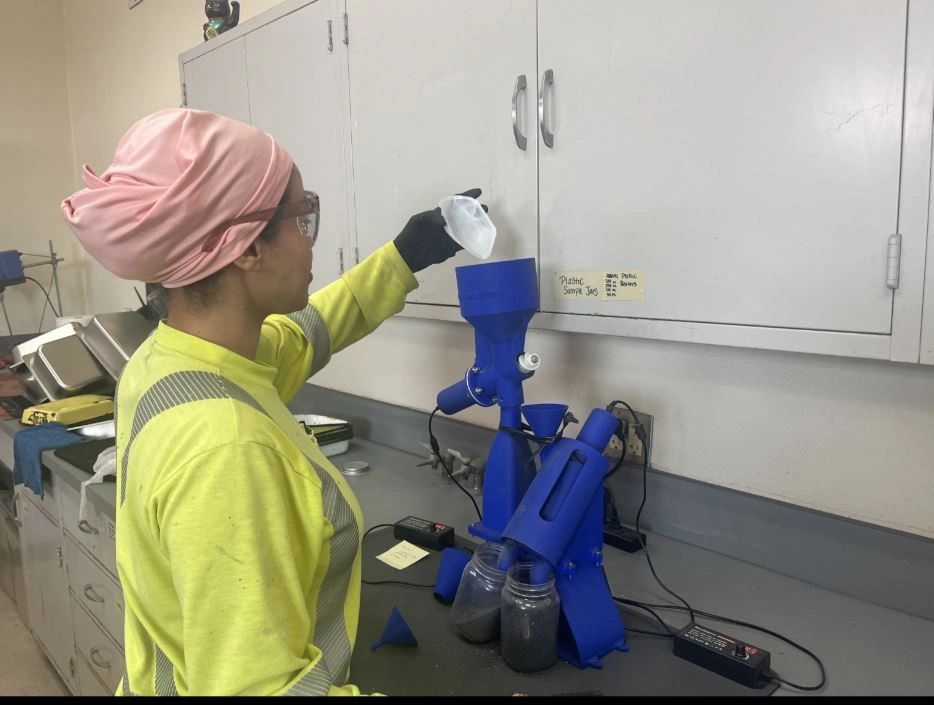
The MiningMagnets Collector was introduced to automate much of the magnetic separation step in the testing workflow.
The Collector was originally designed for laboratory mineral separation and later became widely used by gold prospectors for processing concentrates and removing magnetic material.
In this application at IMC, it is being used in a manner closer to its original laboratory purpose.
Plant personnel continue to collect and dry samples as before. The Collector is then used to perform the repetitive magnetic separation that was previously done manually.
The Collector does not replace the plant’s large-scale industrial magnetic separators.
Those systems are responsible for production-scale recovery.
Instead, the Collector is used for small-scale test samples, helping personnel measure and understand what the full production circuit is doing.
The Results
According to IMC personnel, a test that previously required approximately two hours can now be completed in about:10 Minutes
This represents a significant shift in workflow efficiency.
Notably, ten minutes previously marked the point at which operator fatigue typically began during manual processing. Now, it is the time required to complete the full separation.
The reduction in processing time significantly increased testing capacity.
Testing increased from approximately:2 Samples Per Day
to:More Than 30 Samples Per Day
This is the most impactful outcome of the implementation.
The Collector did more than reduce labor per test.
It increased the amount of process data available to plant personnel.
With more frequent sampling, personnel can evaluate more locations throughout the circuit. When irregularities are detected, additional samples can be taken to further trace the source of magnetite loss.
More data points provide a clearer and more detailed view of plant performance.
Improving Consistency
IMC personnel also report that the Collector provides more consistent and reliable results compared to manual separation methods.
This consistency is important when comparing samples across time and location.
When manual methods are influenced by operator fatigue or variation between technicians, some differences in results may reflect the testing method rather than the process itself.
A more repeatable separation method improves confidence when comparing:
- Different points in the circuit
- Different shifts
- Normal operation versus upset conditions
- Equipment performance before and after adjustments
In process monitoring, consistency can be as valuable as speed.
From the Lab to the Field—and Back to Industry
The Collector has followed an interesting path of adoption.
Originally developed as a laboratory mineral separation tool, it later gained popularity among gold prospectors for processing concentrates and removing magnetic material.
In the IMC application, the technology returns to a more industrial testing environment.
While the scale differs, the underlying principle remains the same:
rapidly and consistently separate magnetic material from a sample so results can be measured accurately.
Potential Beyond Potash
During discussions, IMC also suggested that MiningMagnets engage with magnetite suppliers.
Magnetite suppliers often work closely with operations using heavy-media separation systems. These customers may face similar challenges in understanding:
Where magnetite is being lost and how efficiently it is being recovered.
This indicates potential applicability across other industries that rely on magnetite-based dense media separation.
While plant configurations may differ, the testing challenge is often the same.
Conclusion
Large mineral processing operations rely on complex and highly engineered systems, but meaningful improvements do not always require changes to major production equipment.
In many cases, improvement comes from gaining better visibility into how existing systems are performing.
At IMC in Carlsbad:
Approximately 2 hours became 10 minutes.
Approximately 2 samples per day became more than 30.
The repetitive manual workload was reduced, testing consistency improved, and plant personnel gained significantly greater insight into magnetite movement and loss throughout the circuit.
The result is a more responsive and data-rich approach to process monitoring:
more measurements, more frequently, with greater consistency.
Case Study Summary
Company: International Minerals Carlsbad (IMC)
Industry: Potash / Mineral Processing
Application: Magnetite-loss testing
Location: Carlsbad, New Mexico
Previous Test Time: ~2 hours
Current Test Time: ~10 minutes
Previous Testing Volume: ~2 samples/day
Current Testing Volume: 30+ samples/day
Reported Benefits: Faster testing, reduced manual workload, improved consistency, and increased process visibility
The accompanying process diagram is a generalized heavy-media separation circuit intended to explain common terminology and process flow. It does not represent the exact configuration of the IMC plant.
More product info here:
https://miningmagnets.myshopify.com/products/magnetite-collector